Multi-spindle bar turning: very high-volume production on cam-operated lathes
Key points
- A multi-spindle lathe machines several bars at the same time: each spindle occupies a station and each station performs part of the machining.
- Operations run in parallel, giving the multi-spindle lathe a production rate that no single-spindle lathe can match.
- Cams control the tool movements: once set up, the machine repeats the same cycle hundreds of thousands of times.
- JACQUEMOUX DÉCOLLETAGE operates 10 cam-operated multi-spindle lathes from Tornos, Gildemeister and Wickman, from Ø 3 to 25 mm, for batches of 25,000 to 1,000,000 parts per production run.
———————————–
One million identical parts, all conforming to the drawing: this is where the multi-spindle lathe comes into its own. Whereas a conventional lathe finishes one part before starting the next, the multi-spindle lathe works several bars at once and delivers a finished part with every rotation of its spindle drum.
In this article, we explain how a cam-operated multi-spindle lathe works, for which parts and volumes it becomes the most cost-effective solution, and how we use our fleet of 10 machines in our workshop in Marnaz.
How Does a Multi-Spindle Lathe Work?
From the outside, a multi-spindle lathe looks like a conventional automatic lathe. The difference lies at the heart of the machine, in the way it holds the material, distributes the operations and controls its tools.
One Spindle Drum, Several Spindles, Several Stations
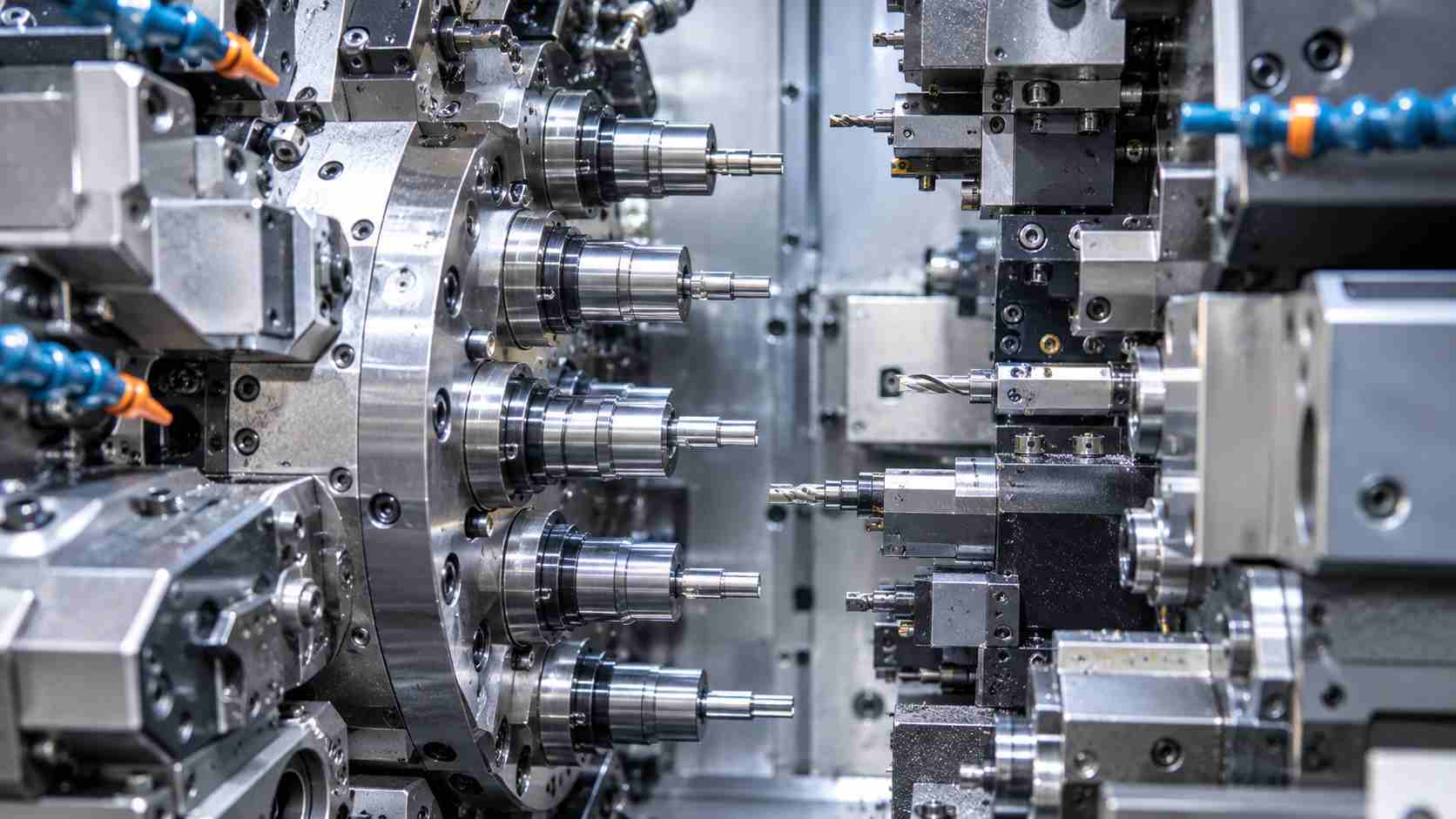
The heart of the machine is called the spindle drum: a rotating drum carrying several spindles, each clamping its own bar of material. On our machines, six bars thus turn at the same time.
Around the spindle drum, each position corresponds to a machining station fitted with its own tools: roughing, drilling, threading, forming, finishing, parting-off. At the end of each cycle, the spindle drum rotates by one step (known as indexing) and each bar moves on to the next station.
All Operations in Parallel
While one station roughs a bar, the next drills the second, another threads the third, and the last parts off a finished piece. The cycle time is therefore no longer the sum of the operations, but the duration of the longest one. This is the principle behind the multi-spindle lathe’s production rate.
To make the most of it, the setter balances the work evenly between the stations: an overly long operation on a single station would slow down the whole machine.
Cams: the Machine’s Mechanical Memory
On a traditional multi-spindle lathe, cams control the movements of the tool slides. Each cam, profiled for a specific part, converts the rotation of a shaft into tool feed, retraction or dwell. The cam set effectively plays the role of the program on a numerical control machine.
Once the cams are fitted and the machine set up, the cycle repeats identically, part after part, with remarkable consistency. Our article on the evolution of bar turning looks at the place these machines still hold alongside numerical control.
Three Manufacturers, One Production Logic
Our multi-spindle fleet brings together three long-established manufacturers, all working with a fixed headstock:
- Tornos, a Swiss manufacturer based in Moutier, in the Jura. According to its official history, it introduced its first cam-operated multi-spindle lathe in 1958. Our 4 Tornos machines machine from Ø 3 to 16 mm.
- Gildemeister, a German manufacturer founded in Bielefeld in 1870, now DMG MORI. Our 5 Gildemeister machines cover Ø 10 to 22 mm.
- Wickman, a British manufacturer founded in Coventry in the 1920s, specialising in multi-spindle automatic lathes. Our Wickman machine works from Ø 10 to 25 mm.
This complementarity allows us to assign each part to the machine whose capacity best matches its diameter.
Which Parts Should Be Produced on a Multi-Spindle Lathe?
Two criteria point a part towards the multi-spindle lathe: the volume to be produced and the stability of its design. When both are met, it generally becomes the most cost-effective solution.
Volumes in the Hundreds of Thousands
The multi-spindle lathe shows its full potential in very high-volume production. Designing the cams and setting up the machine takes time: this initial investment only pays off when spread over a large number of parts. In our workshop, our multi-spindle lathes produce 25,000 to 1,000,000 parts per production run.
Below these volumes, our fixed headstock CNC lathes or sliding headstock CNC lathes offer greater flexibility.
Stable, Repetitive Geometries
The multi-spindle lathe is suited to small and medium-diameter turned parts whose design changes little over time. It is particularly suitable for the following part families:
- screws, nuts and threaded parts;
- short pins and rods;
- spacers, bushes and sleeves;
- inserts and small connector technology components.
They are found in high-volume sectors such as theautomotive, construction andenergy sectors.
What the Multi-Spindle Lathe Requires, and How We Respond
This production rate comes at a price: the multi-spindle lathe requires more preparation than a numerical control lathe. Three points are worth anticipating with your bar turning supplier.
Setup Time to Plan For
Changing part reference on a cam-operated multi-spindle lathe means changing the cams, the tools and the settings of all six stations. This work needs planning: it makes it worthwhile to group requirements into large production runs rather than successive small orders. Our teams will help you define volumes per production run tailored to your forecasts.
Additional Operations as Secondary Operations
The most complex geometries, with cross holes, flats or milling, cannot always be produced entirely on the multi-spindle lathe. Our traditional secondary operation machines (milling, tapping, drilling) and our grinding machine then take over to finish the part. Downstream, our additional services handle surface treatments and sub-assembly.
Geometry to Validate Before Committing to Cams
Designing a cam set for a part whose drawing may still change is costly. Our prototyping and pre-production service lets you validate the geometry, material and machining sequence before launching very high-volume production.
Our Fleet of 10 Cam-Operated Multi-Spindle Lathes
The 10 multi-spindle lathes in our workshop are part of our medium and high-volume production capability. They cover:
- diameters from Ø 3 to 25 mm depending on the machine;
- batches of 25,000 to 1,000,000 parts per production run;
- all our materials: steel, stainless steel, brass, copper, aluminium, titanium and plastics.
Our ISO 9001, IATF 16949 and ISO 14001 certifications govern this very high-volume production, where consistency from one part to the next matters as much as the conformity of the first.
Your Questions About Multi-Spindle Bar Turning
What Is the Difference Between a Multi-Spindle Lathe and a Single-Spindle Lathe?
The single-spindle lathe machines a single bar: it finishes one part before starting the next. The multi-spindle lathe works several bars in parallel, spread across several stations, and delivers a finished part at each indexing of the spindle drum. It therefore achieves a much higher production rate, at the cost of a longer setup.
From What Volume Does a Multi-Spindle Lathe Become Cost-Effective?
It all depends on the part, but the multi-spindle lathe is justified for very high-volume production. At JACQUEMOUX DÉCOLLETAGE, our cam-operated multi-spindle lathes produce 25,000 to 1,000,000 parts per production run.
What Diameters Can Be Machined on a Multi-Spindle Lathe?
Capacity varies by machine. Our fleet covers Ø 3 to 25 mm: Ø 3 to 16 mm on our Tornos machines, Ø 10 to 22 mm on our Gildemeister machines and Ø 10 to 25 mm on our Wickman.
Why Still Use Cam-Operated Lathes?
For a stable part produced in very high volumes, the cam-operated lathe remains a robust and cost-effective solution: once set up, it repeats the same cycle with great consistency. Numerical control keeps the edge as soon as references change frequently or batch sizes decrease.
Planning a Very High-Volume Parts Project?
Send us your drawing and annual volumes: our technical team will identify the most suitable machine and send you a detailed quotation.


