Sliding Headstock CNC Lathe: Bar Turning for Long, Slender Parts

Key points
- The CNC sliding headstock lathe feeds the bar through a guide bush: the tool always works just a few millimetres from the point of support.
- This principle limits deflection and makes it possible to machine long, slender and precise parts, where a fixed headstock would cause the material to vibrate.
- Born in the Swiss Jura Arc for watchmaking, it is also known as the “Swiss-type lathe”.
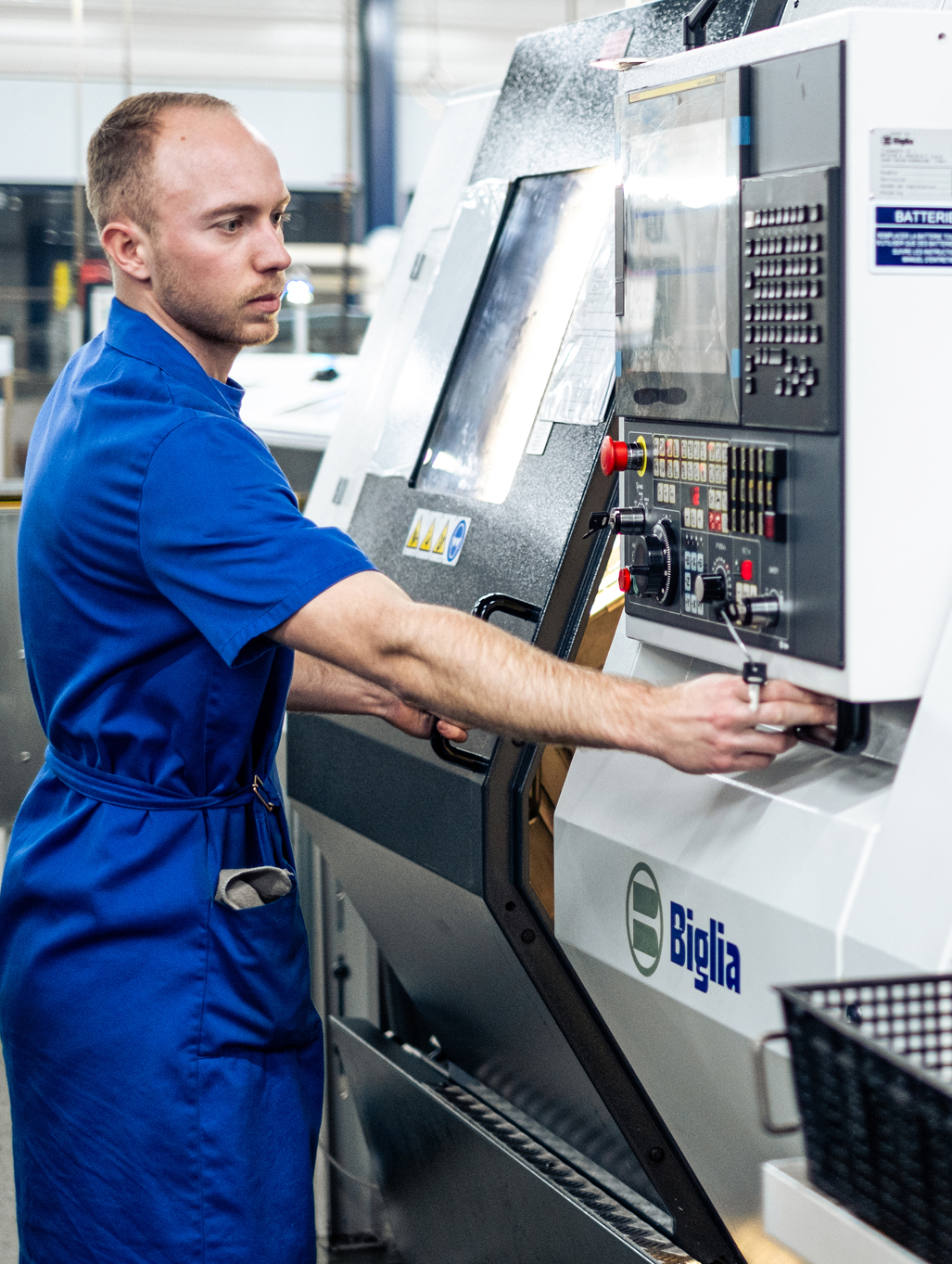
- JACQUEMOUX DÉCOLLETAGE operates 14 Star CNC sliding headstock lathes, from Ø 3 to 24 mm.
———————————–
The machine’s name describes exactly what sets it apart. On a sliding headstock lathe, the assembly that carries the spindle (the headstock) moves along the axis of the part, and it is this movement that controls the machined length. The result: a bar just a few millimetres in diameter can produce a part several times longer, supported from end to end with the same rigidity.
Here we review how this technology works, the parts that call for it, the constraints to anticipate and how we use it in our workshop in Marnaz.
How Does a Sliding Headstock Lathe Work?
The Headstock Advances, the Bar Slides
The spindle clamps the bar in a collet, then the entire headstock moves towards the front of the machine. The bar then passes through a guide bush, a precision bush fixed to the machine bed, behind which the tools are positioned. With every millimetre of headstock feed, an extra millimetre of material is presented to the tool.
Machining therefore progresses in successive sections, always flush with the guide bush. Once the part is finished, the parting-off tool separates it from the bar. On machines fitted with a sub-spindle, the sub-spindle grips the part before parting-off so that the other end can be machined.
The Guide Bush, the Key to Precision
On a fixed headstock, the part protrudes from the collet with an overhang: the longer it gets, the more it bends under the cutting force. The guide bush eliminates this problem. It supports the bar as close as possible to the tool, whatever length has already been machined. The portion of material subjected to the force remains short, and therefore rigid.
This rigidity translates directly into the part: better straightness, consistent diameters along the entire length and fine surface finishes, even on very slender shafts.
A Watchmaking Heritage
The sliding headstock lathe was born in the Swiss Jura Arc to mass-produce the small screws and shafts of watch movements. Hence its other name, still widely used: “Swiss-type lathe” or “Swiss lathe”. Originally cam-driven, the technology moved to numerical control in the second half of the 20th century, like the rest of bar turning (we trace this journey in our article on the evolution of bar turning).
Parts That Call for a Sliding Headstock
Three characteristics point a part towards a sliding headstock: a small diameter, a significant length relative to that diameter, and tight tolerances along that entire length. In our production, this applies in particular to:
- shafts and rods, whose straightness determines the proper functioning of the assembly;
- long screws and small-diameter threaded parts;
- small inserts, sleeves and end fittings with complex shapes;
- parts that combine turning, cross-drilling, flats or milling in a single setup.
These parts are found in sectors such as automotive, paramedical and industry, where repeatability from one part to the next matters as much as the precision of the first.
What to Anticipate Before Launching a Production Run
The sliding headstock is not a universal answer. Several parameters influence the choice:
- A capped diameter: the guide bush capacity sets the limit. In our workshop, our sliding headstock lathes work up to Ø 24 mm. Beyond that, the fixed headstock takes over.
- Calibrated raw material: the bar must slide through the guide bush without excessive play. The consistency of its diameter directly affects part quality, which calls for rigorous sourcing.
- A bar remnant: the portion of bar left in the spindle and guide bush cannot be machined. With costly materials, this factor is included in the cost price calculation.
- Short, bulky parts are poorly suited: a stocky, large-diameter part gains no benefit from the guide bush. It belongs on a fixed headstock lathe.
Our technical team weighs up these points as soon as we study your drawing, to direct each part number to the most cost-effective machine.
Validating the Part in Pre-production Before Full Production
On a sliding headstock, guide bush adjustment, bar selection and the order of operations directly determine part quality. Before committing to a production run, our prototyping and pre-production service lets you validate feasibility on a few parts, then on a pre-production batch of a few dozen to a few hundred units, produced under series conditions. Adjustments to material or machining sequence are made at this stage, rather than once production is under way, when a change costs far more.
Sliding Headstock: Numerical Control or Cams?
The sliding headstock exists on both generations of machines, and our workshop operates both.
With numerical control, our Star lathes cover medium-volume runs and complex geometries. Switching part numbers simply means loading a new program, with no cam set to manufacture.
In the cam-operated version, our Tornos sliding headstock single-spindle lathes machine from Ø 2 to 10 mm. Once the cam set is adjusted, they produce very high volumes of simple parts, from 25,000 to 1,000,000 parts per production run. We will return to these machines in a forthcoming article dedicated to single-spindle lathes.
Our 14 Star CNC Sliding Headstock Lathes
Star, a Japanese manufacturer of Swiss-type automatic lathes, equips our fleet of CNC sliding headstock machines. Our 14 machines cover:
- diameters from Ø 3 to 24 mm;
- runs of 100 to 100,000 parts per production run;
- all our materials: steel, stainless steel, brass, copper, aluminium, titanium and plastics.
These lathes are part of our medium and high-volume production capability, alongside our fixed headstock lathes, multi-spindle lathes and cam-operated single-spindle lathes. Certified ISO 9001, IATF 16949 and ISO 14001, our organisation oversees every production run, right through to delivery.
Your Questions About the Sliding Headstock Lathe
Are the Sliding Headstock Lathe and the Swiss Lathe the Same Machine?
Both terms refer to the same technology. “Swiss-type lathe” recalls the machine’s watchmaking origins in the Jura Arc. “Sliding headstock lathe” describes its principle: the headstock moves to feed the bar through the guide bush.
What Is the Guide Bush For?
It supports the bar just in front of the tool. The material never works with a long overhang, which prevents deflection and vibration. It is this support that makes precise machining of long, slender parts possible.
What Is the Maximum Diameter That Can Be Machined on a Sliding Headstock Lathe?
The limit depends on the machine model. At JACQUEMOUX DÉCOLLETAGE, our Star CNC sliding headstock lathes machine from Ø 3 to 24 mm. For larger diameters, our fixed headstock lathes go up to Ø 60 mm in bar and Ø 150 mm in billet.
Can Small Batches Be Produced on a Sliding Headstock?
Numerical control makes it possible: our Star lathes start from 100 parts per production run. However, setup time remains longer than on a fixed headstock, which makes the sliding headstock most cost-effective from medium-volume runs upwards.
A Drawing for a Long or Small-Diameter Part?
Send us your drawing and forecast volumes: we will recommend the most suitable technology and send you a detailed quotation.