Fixed-headstock numerical control bar turning for machining large-diameter parts
KEY POINTS
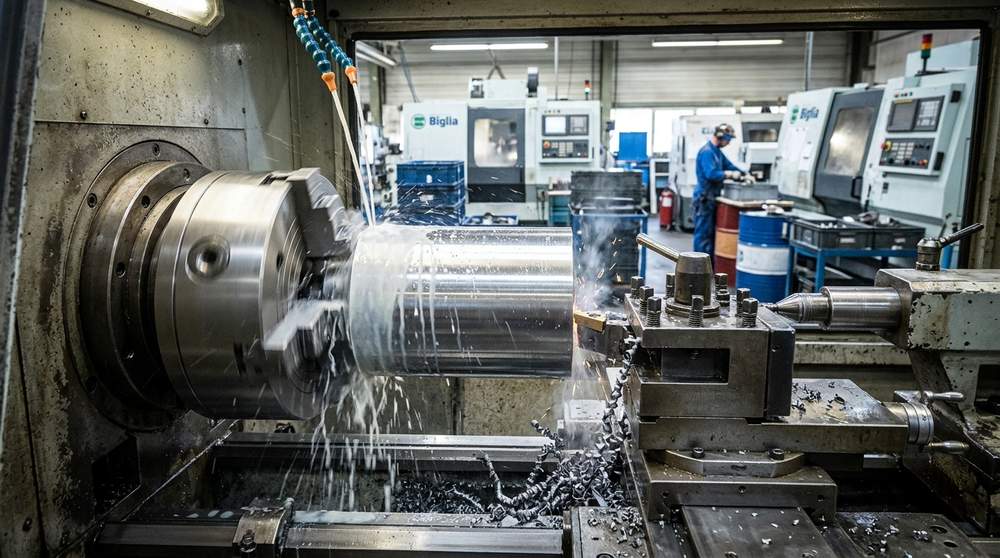
- On a fixed headstock lathe, the spindle driving the material stays stationary: the tools perform all movements along the part.
- This rigid architecture suits large-diameter, short and solid parts with heavy material removal.
- The fixed headstock lathe works from bar or billet, which considerably extends the range of achievable diameters.
- JACQUEMOUX DÉCOLLETAGE operates 10 Biglia fixed headstock CNC lathes, from Ø 14 to 60 mm in bar and up to Ø 150 mm in billet.
———————————–
A Ø 50 mm fitting body, a thick-walled bush or a heavy-section nut all start from a bulky blank, from which the tool must remove a large amount of material without losing precision. For this type of part, the bar turner relies on a robust machine designed to withstand cutting forces: the fixed headstock lathe.
This article explains how it works, how it is fed, the parts for which it makes the difference and its strengths in production. It draws on the experience of our workshop in Marnaz, in the Arve Valley, where our Biglia lathes produce medium and large-diameter parts every day.
Fixed headstock lathe: definition and operating principle
A stationary spindle, moving tools
The headstock is the assembly that carries the spindle and rotates the material. On a fixed headstock lathe, this assembly does not move: the spindle rotates without ever advancing or retracting. The bar or billet remains clamped in a collet or chuck.
The tool slides perform all the movements. They come into contact with the material and follow the profile of the part lengthwise (Z axis) and in depth (X axis). On a CNC lathe, the numerical control drives these axes and links longitudinal turning, facing, drilling, boring, threading and parting-off in a single cycle.
Rigidity, a direct result of this architecture
The part protrudes from the collet as an overhang: only its clamped end holds it. As long as its length remains modest relative to its diameter, this setup offers excellent holding. The solid, stationary spindle absorbs cutting forces without vibration.
It is this rigidity that makes the fixed headstock lathe so valuable: it allows deep passes, heavy material removal and large diameters, while preserving surface finish quality.
Bar or billet: two ways to feed the machine
Bar machining for series production
In production, a bar feeder pushes the bar into the spindle cycle after cycle. The machine machines the part, parts it off, then advances the bar for the next part, with no operator intervention between parts. In our workshop, our Biglia lathes work in this way from Ø 14 to 60 mm.
Billet machining for very large diameters
Beyond bar capacity, the operator loads billets: pieces of material already cut to length, clamped one by one in the chuck. This method avoids tying up a very large-diameter bar over its entire length and gives access to solid parts. Our Biglia lathes machine up to Ø 150 mm in this way.
The specific features of large-diameter machining
Machining a large diameter is not simply a matter of scaling up a small part. Several parameters change:
- Rotational speed: cutting speed depends on both rotational speed and the diameter being machined. The larger the diameter, the slower the spindle must turn to maintain a cutting speed suited to the material and the tool.
- Cutting forces: a large section means more material to remove and higher forces on the tool, which only a rigid machine can withstand without dimensional drift.
- Chip control: heavy material removal produces a large volume of chips, which lubrication and tool geometry must evacuate efficiently, particularly with stainless steel and alloy steels.
- Internal features: on a heavy-section part, internal drilling, boring and threading take up a significant share of the cycle. The numerical control links them in the same clamping as the external features.
Which parts should be machined on a fixed headstock lathe?
The fixed headstock lathe comes into its own whenever a part combines a medium to large diameter with a reasonable length relative to that diameter. Among the parts we regularly produce on our Biglia lathes:
- fluid circuit bodies and fittings, with internal drilling, boring and threading;
- medium and large-diameter bushes, nuts and plugs;
- solid spacers and end fittings;
- large inserts.
These types of parts are found in markets such as energy, the construction sector and machinery and equipment.
Conversely, long, slender small-diameter parts, such as thin shafts, would bend in overhang. We produce them on our sliding headstock lathes, presented in our dedicated article on the sliding headstock lathe.
Entrust your parts to JACQUEMOUX DÉCOLLETAGE
The strengths of the fixed headstock lathe in production
- High machining rigidity: the stationary spindle withstands high cutting forces, on soft and hard materials alike.
- Flexible raw material sourcing: the machine accepts drawn or rolled bars as well as billets cut to length.
- Flexibility on medium runs: numerical control allows switching from one part number to another by changing the program, without making a cam set.
- Complete operations in one clamping: a single cycle links external and internal features, limiting rework and handling.
Our 10 Biglia fixed headstock lathes
Biglia, an Italian manufacturer of numerical control lathes, supplies our workshop’s fixed headstock machines. We operate 10 of these machines, covering:
- diameters from Ø 14 to 60 mm in bar and up to Ø 150 mm in billet;
- runs of 250 to 20,000 parts per batch;
- all our materials: steel, stainless steel, brass and copper alloys, aluminium, titanium and plastics.
These lathes are part of our medium and high-volume production capacity. Downstream, our additional services handle secondary machining, surface treatments and sub-assembly. Our quality organisation is backed by ISO 9001, IATF 16949 and ISO 14001 certifications.
To validate a geometry before series production, our prototyping and pre-production service produces the first parts on the same equipment as production.
Frequently asked questions about the fixed headstock lathe
Up to what diameter can a fixed headstock lathe machine?
It all depends on the machine’s capacity. At JACQUEMOUX DÉCOLLETAGE, our Biglia fixed headstock CNC lathes machine from Ø 14 to 60 mm in bar, and up to Ø 150 mm in billet.
What is billet machining?
A billet is a piece of material cut to length before machining. The operator loads it directly into the lathe chuck, instead of feeding the machine with continuous bar. This method suits very large-diameter parts, for which bar feeding would be neither practical nor cost-effective.
What run sizes suit a fixed headstock CNC lathe?
Numerical control makes the fixed headstock lathe relevant from medium runs upwards: our Biglia lathes produce 250 to 20,000 parts per batch. For very high-volume production of simple parts, our cam-operated lathes take over.
Is your part suited to a fixed headstock?
Send us your drawing: our technical team will study your geometry, material and volumes, then send you a detailed quotation.


