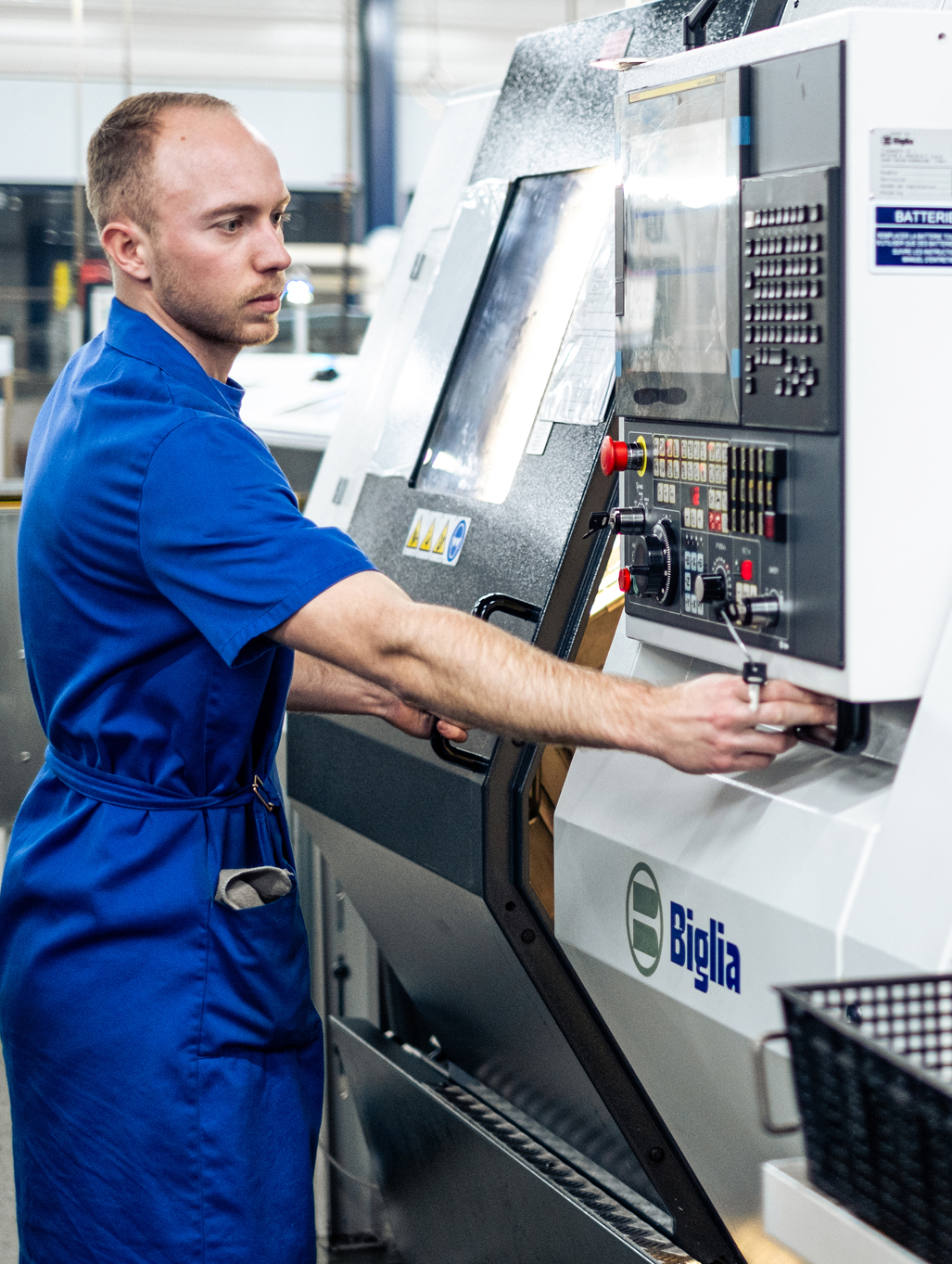
Aluminium bar turning: mastery of grades and precision parts

Key takeaways:
- Aluminium can withstand cutting speeds 3 to 5 times higher than steel: a key advantage for productivity in high-volume production.
- The choice of grade is decisive: 2024 and 7075 for high strength (aerospace, defence); 6061 and 6082 for a versatile compromise; 5052 for corrosive environments.
- 2xxx (2024) and 7xxx (7075) grades anodise poorly and cannot be welded : they are reserved for mechanical assemblies with surface protection.
- The supply form (round, hexagonal, square, billet) directly determines the geometry of the part: anticipating this choice reduces machining costs.
- Lubrication and chip control are the two critical parameters: neglecting them degrades the surface finish and causes premature tool wear.
————–
Aluminium is today one of the most widely machined materials in industrial bar turning. Lightweight, conductive, anodisable and available in a wide range of grades with very different properties, it meets the requirements of a broad variety of sectors: aerospace, automotive, medical, electronics and general industry.
At JACQUEMOUX DÉCOLLETAGE, we produce bar-turned aluminium parts (round, hexagonal, square, complex) in both high-volume production and small batches. This article offers a technical overview of the main aluminium grades used in bar turning, from their mechanical characteristics to their machining constraints, to help you make the right material selection.
Why Choose Aluminium for Bar Turning?
Aluminium offers a combination of properties that make it a material of choice for bar turning industrial mechanical parts:
- Lightness: a density of around 2.7 kg/dm³, almost three times lower than steel, with an excellent strength-to-weight ratio in high-strength grades.
- High machinability: most aluminium alloys cut easily, allowing high cutting speeds and a good surface finish. In high-volume production, this gain in production rate is significant.
- Corrosion resistance: the natural oxide layer protects the surface. Depending on the grade, this property can be enhanced by anodising.
- Versatile supply forms: round, hexagonal and square bars, flats, tubes – aluminium comes in a wide variety of profiles, suited to standard round parts as well as hexagonal or complex parts.
The Main Aluminium Grades Used in Bar Turning
2xxx Series: Aluminium-Copper Alloys for Demanding Machining
2xxx series alloys have copper as their main alloying element. They offer high mechanical strength (up to 470 MPa tensile strength for 2024 in the T3 temper), but their corrosion resistance is more limited than that of the 5xxx or 6xxx series, owing to their copper content. They generally require a protective coating or anodising.
The aluminium grades most commonly encountered in bar turning are:
- 2024: the benchmark grade in aerospace for its high strength and good fatigue resistance. It tends to distort during machining owing to residual stresses, so the machining sequence must be carefully planned.
- 2011 (free-machining grade): specially designed for fast high-volume production. Short, regular chips and excellent productivity. It has gradually replaced 2030 and 2007 for environmental reasons (presence of lead and bismuth).
Good to know: 2xxx grades are not recommended for welding (risk of hot cracking) and anodise poorly because of their copper content. They are suited to machined parts with mechanical assembly.
5xxx Series: Aluminium-Magnesium Alloys, the Anti-Corrosion Choice
The 5xxx series, whose most common representative in bar turning is 5052, is characterised by excellent corrosion resistance and very good weldability. However, its machinability is less favourable than that of the 2xxx or 6xxx series: 5052 has higher elasticity and produces larger chips, which can lead to increased tool wear and reduced precision in high-speed bar turning.
5052 is the preferred choice for parts exposed to damp or corrosive environments, and for assemblies that must be welded. For high-volume bar turning with tight tolerances, the 6xxx or 2xxx series are generally more suitable.
6xxx Series: Aluminium-Magnesium-Silicon Alloys, the All-Round Choice
6xxx series alloys are the most versatile. 6061 and 6082 machine well, weld satisfactorily, anodise perfectly and resist corrosion. They are the cost-effective, reliable choice for most mechanical parts in the aerospace and automotive industries.
- 6061: an excellent compromise between machinability, weldability and strength. It allows high-speed machining, tight tolerances and high-quality surface finishes. Tensile strength of around 310 MPa in the T6 temper. Very widely used in automotive, aerospace and general engineering.
- 6082: the strongest grade in the 6xxx series, with a tensile strength of up to 340 MPa in the T6 temper. Very widespread in Europe, it has gradually replaced 6061 in many structural applications. Good machinability in the T5 and T6 tempers, with chip breakers recommended to improve chip formation.
Good to know: 6061 alloy is a good compromise between machining, welding and strength, but 6082 alloy is preferable when structural strength is the priority.
7xxx Series: Aluminium-Zinc Alloys, Maximum Strength
The 7xxx series, and 7075 in particular, is the ultimate high-strength aluminium. With a tensile strength of up to 572 MPa in the T6 temper, it is comparable to some mild steels. It is the strongest aluminium alloy commonly available on the market.
Its machinability index is around 70% compared with free-cutting brass. High-speed machining with abundant coolant flow is recommended to avoid work hardening. However, 7075 has significant limitations: very poor weldability (risk of cracking), reduced corrosion resistance under stress, and an almost systematic need for surface treatment (anodising, coating).
Its applications are mainly in the aerospace, defence, motorsport and high-performance sports equipment sectors – wherever mechanical strength takes precedence over weldability or chemical resistance.
Supply Forms and Part Geometries
One of the strengths of aluminium bar turning is the variety of bar shapes available, which opens up a very wide range of finished part geometries:
- Round bars: the most common form, suitable for all grades and for most turned parts (shafts, bushes, screws, fittings, etc.).
- Hexagonal bars: allow hexagonal heads, fasteners and inserts to be produced without an additional milling operation, reducing cycle time.
- Square bars and flats: suitable for parts with a rectangular geometry or square aluminium parts machined on CNC lathes with secondary operations.
- Billets (large sections): for complex large-section aluminium parts, prototypes and medium-sized batches requiring several operations.
This variety of input forms, combined with a diverse machine fleet, enables JACQUEMOUX DÉCOLLETAGE to produce complex aluminium parts with ease.
Key Parameters for Machining Aluminium in Bar Turning
Aluminium is generally easier to machine, but it has its own technical constraints that need to be mastered:
- High cutting speed: aluminium withstands very high cutting speeds (often 3 to 5 times higher than steel). In high-volume production, this means short cycle times and competitive unit costs.
- Chip control: some grades (6082, 5052) tend to produce long chips that can wrap around the tool. Using suitable chip breakers and the appropriate tool geometry is essential.
- Lubrication is essential: to prevent aluminium from sticking to the cutting edges (built-up edge). Abundant coolant flow improves surface finishing and extends tool life.
- Residual stresses (2xxx and 7xxx grades): 2024 and 7075 can distort after machining if internal stresses are not anticipated. Defining the machining sequence and the order of operations is critical to ensuring dimensional stability.
- Post-machining surface treatments: anodising, shot blasting, painting, etc. Some grades anodise better than others. For example, 6061 and 7075 anodise well, whereas 2024 anodises poorly because of its copper content and requires a suitable protective coating. This should be considered right from the choice of grade.
JACQUEMOUX DÉCOLLETAGE’s Aluminium Expertise
High-precision aluminium bar turning requires simultaneous mastery of grades, machining parameters and the constraints associated with surface treatments and final tolerances. At JACQUEMOUX DÉCOLLETAGE, we support our customers at every stage:
- Upstream grade advice: we guide you towards the grade best suited to your application – mechanical strength, corrosion resistance, suitability for anodising, welding constraints – to optimise both part performance and manufacturing productivity.
- Variety of geometries: round, hexagonal, square and complex multi-axis parts – our machine fleet handles every aluminium supply form available on the market.
- Small batch and high-volume production: from prototype to industrial series, with the same rigorous dimensional inspection and material traceability.
Aluminium bar turning covers a very wide range of grades, geometries and industrial applications. From aerospace-grade 2024 to structural 6082, via high-strength 7075, each alloy has its own rules and potential. Mastering these materials also means anticipating machining constraints, residual distortion and surface treatment requirements.
Do You Have a Bar-Turned Aluminium Parts Project?
From defining the grade to delivering your finished parts, the JACQUEMOUX DÉCOLLETAGE technical team will study your specifications and propose a solution tailored to your dimensional requirements, volumes and lead-time constraints.