Steel bar turning: a guide to grades, machinability and key points to watch

Key takeaways:
- Bar turning produces turned parts in high-volume production with high dimensional accuracy.
- Free-cutting steels (11SMn30, 11SMnPb37…) are optimised for high production rates.
- Austenitic stainless steels (303, 304, 316L) require specific cutting conditions.
- Alloy steels (42CrMo4, 16MnCr5) are machined before heat treatment, with careful tolerance management.
- Bar diameter (Ø 3–65 mm) or billet (up to Ø 150 mm): the format determines the process.
————–
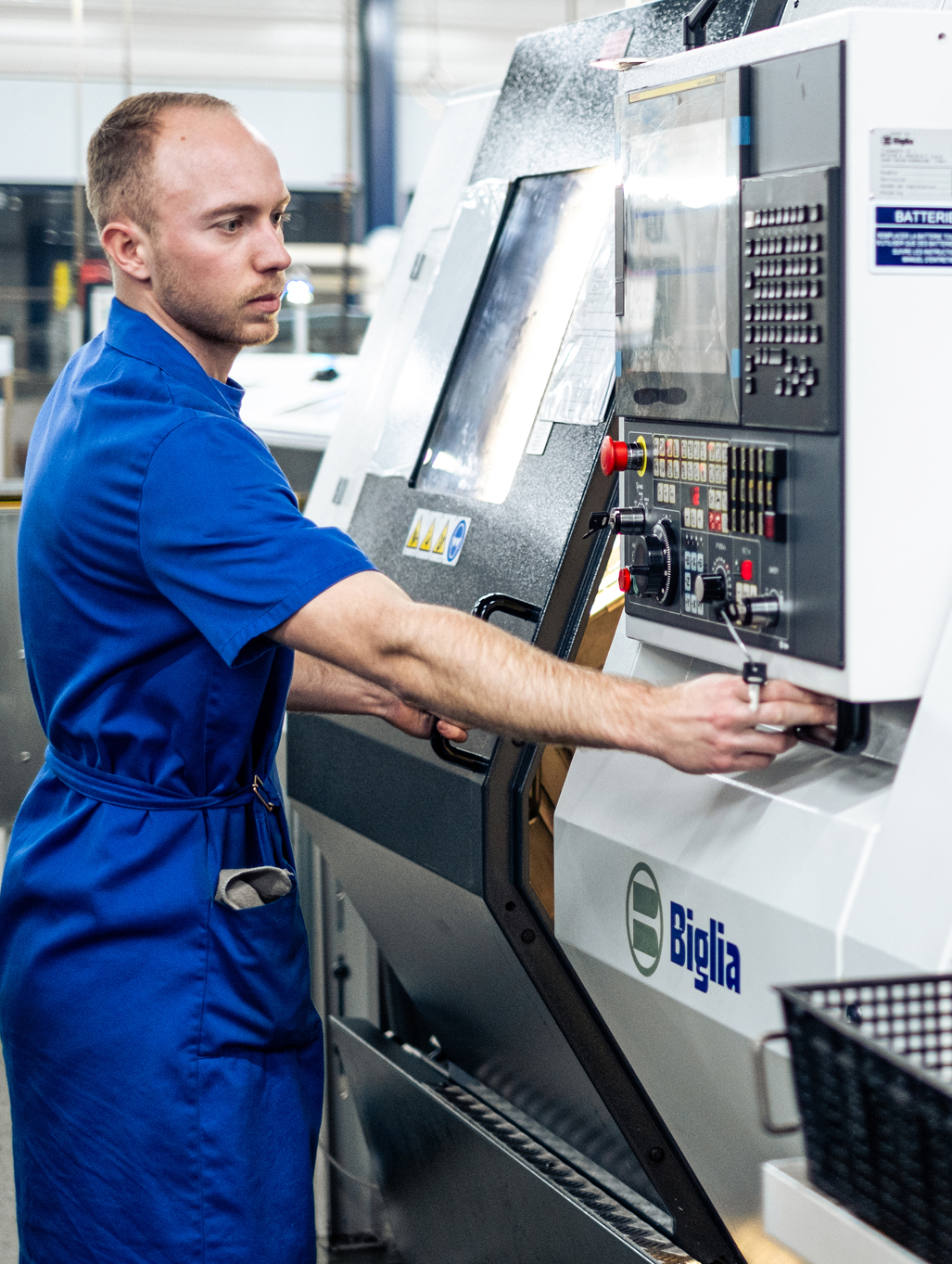
Steel bar turning, i.e. machining steel by material removal on numerical control lathes, makes it possible to produce turned parts in high-volume production with high dimensional accuracy: screws, shafts, bushes, fittings, inserts and connectors.
However, not all steels behave in the same way in this process. Between a free-cutting steel designed for high production rates and an alloy steel intended for heat treatment, the requirements in terms of machining, lubrication and dimensional inspection are radically different. This article presents the main families of steels machined in bar turning, their specific characteristics and the technical parameters that must be mastered to guarantee compliant, repeatable parts.
Steel Bar Turning: Principles and Applications
Steel bar turning refers to the machining of steel by material removal on numerical control lathes. This process makes it possible to produce turned parts in high-volume production – screws, shafts, bushes, fittings, inserts and connectors – with high dimensional accuracy and repeatability suited to industrial volumes. Mastery of the process depends on matching the chosen steel grade, the cutting parameters and the equipment used: it is this combination that guarantees part conformity and production run productivity.
The Main Families of Steels Machined in Bar Turning

Free-Cutting Steels (or Sulphurised Steels)
Designed for high-rate machining, free-cutting steels contain sulphur and, depending on the grade, lead, bismuth or tellurium. Sulphur forms manganese sulphide precipitates which promote chip breaking and prevent stringy chips. Lead, with its low melting point, generates a lubricating layer that reduces tool/workpiece friction and extends tool life.
Good to know: Lead (Pb) in free-cutting steels is gradually being replaced by bismuth (Bi) or tellurium (Te) for environmental and regulatory reasons (REACH Regulation). So-called “lead-free” grades offer comparable machinability.
These steels are suited to parts for connector technology, taps and valves, screws and fasteners, and instrumentation, where dimensional requirements are high but mechanical stresses are moderate. They are supplied as cold-drawn or hot-rolled bars, the ideal format for continuously feeding automatic lathes.
Austenitic Stainless Steels
Essential whenever parts must resist corrosion or meet hygiene requirements, stainless steels (303, 304, 316L) are more demanding to machine. Austenitic stainless steel tends to stick to cutting edges and produce long chips that are difficult to evacuate.
Mastering them requires suitable cutting conditions: tools with positive rake geometry, effective lubrication, and optimised speeds and feed rates. Grade 303, with added sulphur, offers significantly better machinability than 304 or 316L: it is the preferred choice in bar turning when chemical resistance is not critical.
Heat-Treatable Steels (Alloy and Case-Hardening Steels)
For applications requiring high mechanical strength or significant surface hardness, alloy steels such as 42CrMo4, 16MnCr5 or 100Cr6 (bearing steel) are used. These materials are generally machined in the annealed or normalised condition, then subjected after machining to heat treatment (quenching, tempering, case hardening, nitriding) to achieve their final properties.
Bar turning these steels requires particular attention to tolerances, as heat treatments cause dimensional variations. Defining any grinding allowance and controlling dimensions before treatment are an integral part of the bar turner’s expertise.
The Question of Diameter and Supply Form
The form in which the steel is supplied directly determines the production method and the equipment used.
- Bars (Ø 3 to 65 mm): fed continuously into fixed or sliding headstock automatic lathes, they enable uninterrupted high-volume production. The bar diameter directly determines the maximum diameter of the blank and the type of lathe used.
- Billets (up to Ø 150 mm): sections of bar sawn to length, they make it possible to machine larger-diameter or longer parts on numerical control (CNC) lathes. The operator loads the billets manually or via a magazine. This approach is preferred for large-section parts, prototypes and medium-sized runs.
Key Parameters for Machining Steel in Bar Turning
Whatever the steel grade being machined, several technical parameters are decisive in achieving compliant parts and optimum productivity:
- Cutting speed and feed rate: these must be adapted to the grade and the target surface finish. A free-cutting steel such as 11SMn30 can withstand cutting speeds of around 200 to 300 m/min, whereas an austenitic stainless steel requires a reduction to 80-120 m/min to avoid premature tool wear. The feed rate, combined with the speed, directly determines the surface finish and the service life of the cutting edges.
- Cutting tool geometry: Each steel family requires a specific tool geometry. Free-cutting steels tolerate neutral or slightly positive geometries. Austenitic stainless steels require pronounced positive rake angles to prevent surface work hardening and sticking on the edge. Hard alloy steels require suitable coatings to withstand the high temperatures generated during cutting.
- Lubrication and cooling: Lubrication serves two distinct purposes: dissipating the heat generated during cutting and facilitating chip evacuation. For free-cutting steels, standard lubrication is generally sufficient. For austenitic stainless steels, high-pressure lubrication (up to 80 bar in certain configurations) is needed to break long chips and prevent build-up on the tool.
- In-process dimensional inspection: Steels expand differently depending on their composition and thermal conductivity. A temperature difference of 10°C during production can cause dimensional variations of a few microns on a stainless steel part – enough to fall outside a tight tolerance. Regular monitoring of dimensions is essential to guarantee conformity across the entire run.
JACQUEMOUX DÉCOLLETAGE Expertise: From Material to Delivered Part
Working steel in bar turning is not simply a matter of programming a lathe. It is a chain of skills that runs from the choice of grade to the metrological validation of the finished part, including the definition of machining sequences, tool setting and the management of non-conformities.
JACQUEMOUX DÉCOLLETAGE is involved from the enquiry stage to guide the choice of grade according to functional constraints and production volumes, including when a material optimisation can improve machinability without compromising the part’s mechanical properties.
With a capacity ranging from Ø 3 mm in bar to Ø 150 mm in billet, the machine fleet covers a particularly wide spectrum: from micro-components for connector technology to massive structural parts, everything is produced on one and the same site, without subcontracting.
Each run is inspected according to a defined control plan, with full traceability of materials and inspections from steel receipt through to delivery. The measuring equipment is suited to the required tolerances, whether for in-line inspections or off-line sampling.