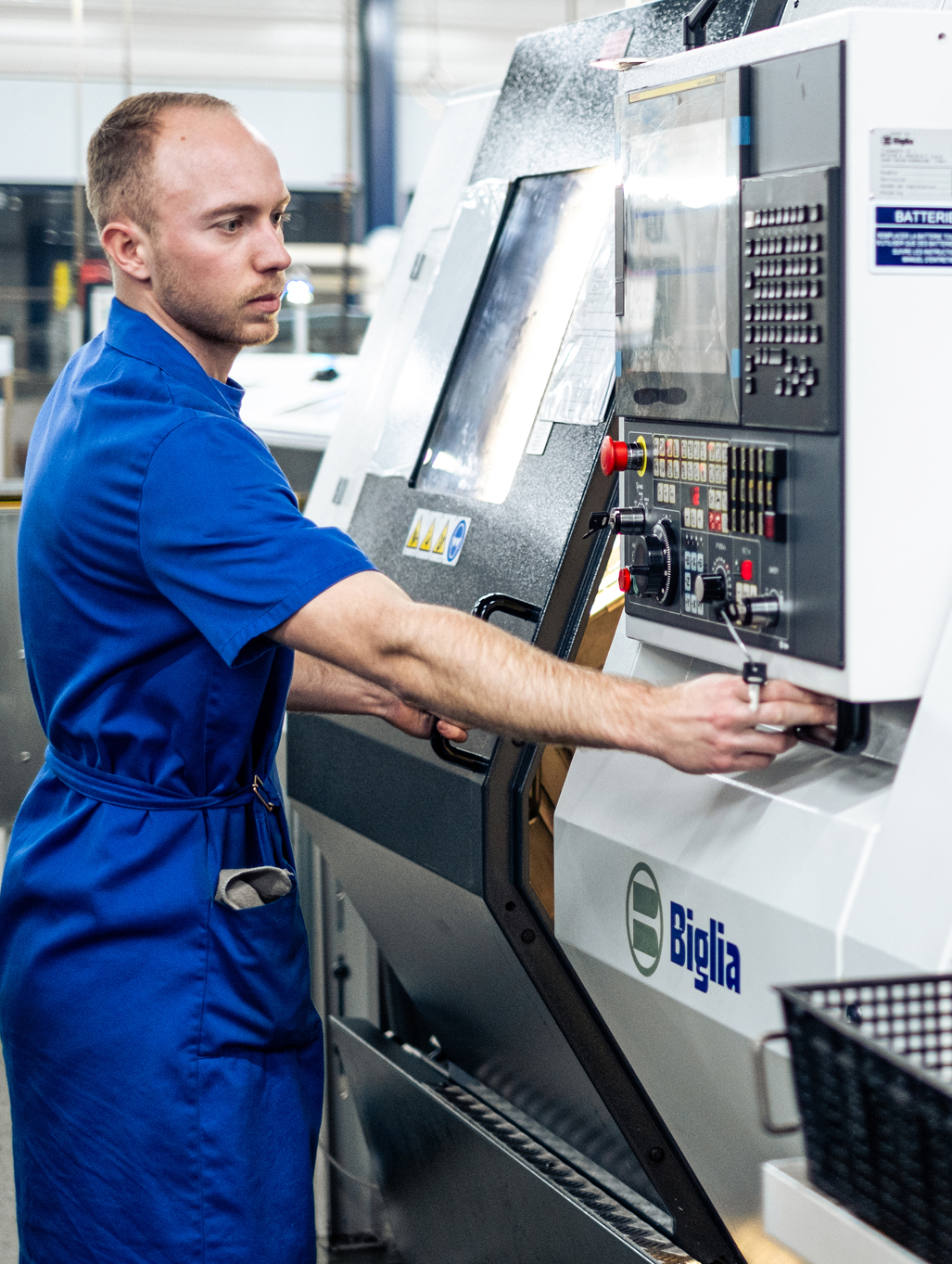
Stainless steel bar turning: meeting the challenge of complex parts with precision

Key takeaways:
- Stainless steel does not forgive approximation: rapid work hardening and low thermal conductivity concentrate heat on the cutting edge and make dimensional control more difficult.
- 1.4305 (AISI 303), with 0.15 to 0.35% sulphur, is the benchmark grade in bar turning thanks to the natural fragmentation of its chips; 316L and 17-4PH become essential whenever corrosion resistance or mechanical strength takes priority, particularly in aerospace and medical applications.
- JACQUEMOUX DÉCOLLETAGE, a family business founded in 1960 in the Arve Valley and certified ISO 9001, IATF 16949 and ISO 14001, brings to these constraints an expertise built on thousands of production runs.
- The cost of a turned stainless steel part depends on the grade, geometric complexity, tolerances and batch volume: precise specifications remain the best guarantee of a reliable quotation.
——-
On a lathe, stainless steel forgives nothing: a poorly calibrated cutting speed or unsuitable lubrication, and the part ends up as scrap – or worse, it passes inspection only to fail in service. Yet stainless steel has become indispensable wherever corrosion resistance, mechanical strength and material cleanliness are required: aerospace, medical, automotive, energy.
This article details the properties of stainless steel that determine how it is machined, the technologies and expertise needed to bar-turn complex parts, and the factors that influence the quality and cost of the parts produced.
Why Stainless Steel Imposes Specific Constraints on Bar Turning
Stainless steel does not behave like the other metals commonly used in bar turning. Its corrosion resistance and mechanical strength, which make it so valuable in use, are also the source of its main machining difficulties.
Mechanical and Chemical Properties of Stainless Steel Affecting Machining
- Rapid work hardening: under the action of cutting, the surface of austenitic stainless steel hardens locally. A poorly set feed rate or cutting speed creates a work-hardened layer a few tens of microns thick, harder than the base material, which accelerates tool wear and degrades dimensional repeatability if it is not controlled from the very first pass. This phenomenon requires passes deep enough to cut beneath the already work-hardened layer – an approach that can seem counter-intuitive to anyone used to machining aluminium.
- Low thermal conductivity: around 15 to 16 W/(m.K) for common austenitic grades, compared with nearly 50 W/(m.K) for carbon steel. The heat generated by cutting dissipates poorly through the part and concentrates on the tool edge, which calls for rigorous lubrication and cooling.
- High toughness and mechanical strength: between 500 and 1,000 MPa depending on the grade. The austenitic structure gives stainless steel good ductility but also a tendency to “stick” to the tool, with a risk of built-up edge that degrades the surface finish.
- Long, sharp chips: on non-resulphurised grades, stainless steel forms stringy chips that do not break up naturally. Beyond the impact on surface finish, it should be remembered that these chips pose a real risk to operators, which justifies paying particular attention to chip management right from process design.
- Corrosion resistance: ensured by a chromium content of at least 10.5%, reinforced by nickel and, for certain grades, molybdenum. This is the property sought first and foremost for medical and food applications and for those exposed to saline or chemical environments.
The Most Common Types of Stainless Steel in Bar Turning
Three families dominate the production of turned parts, and the choice of grade directly determines the cutting parameters and the performance of the finished part:
- Austenitic grades (304/1.4301, 304L/1.4307, 316L/1.4404-1.4435): the most widespread, with excellent corrosion resistance and good weldability, but a marked tendency to work harden. 316L, enriched with molybdenum, is the benchmark grade for saline and chlorinated environments, medical and aerospace applications.
- Martensitic grades (410, 420): harder and easier to machine than austenitic grades, but more susceptible to corrosion. Used for parts requiring high hardness after heat treatment. 17-4PH (1.4542), a precipitation-hardening martensitic grade, reaches around 40 to 45 HRC after treatment and combines high mechanical strength with good corrosion resistance, at the cost of tricky machinability and increased tool wear. It is used notably in medical instruments and highly stressed aerospace parts.
- Free-machining grades (1.4305/AISI 303, 416): formulated with added sulphur (0.15 to 0.35% for 303), which naturally breaks up the chip and makes machining considerably easier, at the cost of slightly reduced corrosion resistance. This is the grade to favour whenever the specifications allow, particularly for high-volume production.
- Duplex grades (e.g. 1.4462): a mixed austenitic-ferritic structure offering higher corrosion resistance and mechanical strength than conventional austenitic grades. Reserved for the most demanding applications in the energy sector, they require even more cautious cutting parameters.
The Role of Controlling Cutting Parameters and Lubrication
Successful stainless steel machining depends above all on consistent cutting parameters:
- Controlled cutting speed: generally between 80 and 200 m/min with coated carbide tools on austenitic stainless steel, depending on the grade and part geometry. Too slow, and the tool rubs instead of cutting and work hardening spirals; too fast, and the heat degrades the coating within minutes. This working window is defined as much by experience as by calculation.
- Sufficient, constant feed rate: an insufficient feed rate passes over material already work-hardened by the previous pass, accelerating tool wear disproportionately. Consistency of feed rate matters more than raw cutting speed in limiting this phenomenon.
- Abundant, targeted lubrication: high-pressure coolant, directed as close as possible to the cutting edge, cools the cutting zone and creates a film that reduces tool-to-part friction. On the least machinable grades, a high-performance neat cutting oil specifically formulated for stainless steel significantly extends the life of carbide tools compared with a standard oil – a difference that weighs directly on tooling costs in high-volume production.
- Chip management: essential on non-sulphurised grades (304, 316L, 17-4PH), whose chips remain continuous and stringy if the tool geometry is not suitable.
The combination of these parameters, adjusted grade by grade and part by part, directly determines the production rate achievable in series and the consistency of surface finish from one part to the next.
How to Optimise the Quality and Durability of Turned Stainless Steel Parts
Quality Control and Traceability in Production
A well-machined stainless steel part is a part that is measured, documented and traceable (some sectors, such as aerospace and medical, require this contractually). Material traceability begins as soon as the bars are received: each batch is identified by its EN 10204 material certificate (notably type 3.1) and its grade verified, with no anonymous bar ever allowed into production.
During manufacturing, dimensional inspections are carried out using height gauges, dial indicators and coordinate measuring machines (CMM), particularly on the tightest tolerances. For critical parts, non-destructive testing (dye penetrant testing, magnetic particle inspection, ultrasound) completes the system in line with the specifications, detecting internal and surface defects invisible to the naked eye before shipment.
JACQUEMOUX DÉCOLLETAGE is certified ISO 9001, IATF 16949 and ISO 14001, the latter covering environmental management. This foundation structures material traceability and meets the quality requirements of the most demanding customers.
JACQUEMOUX DÉCOLLETAGE Expertise for Your Stainless Steel Parts
Since 1960, we have built our response to these challenges around a number of concrete strengths:
- Hands-on experience with stainless steel: thousands of production runs for industry, energy, automotive and the paramedical sector, even supplying projects as demanding as the 24 Hours of Le Mans.
- A comprehensive machine fleet: 25 CNC lathes with fixed or sliding headstock, 10 cam-operated multi-spindle lathes and 24 cam-operated single-spindle lathes, to handle in a single bar clamping both simple parts in high-volume production and complex geometries, from Ø 3 to 60 mm in bar and up to Ø 150 mm in billet.
- Three quality certifications: ISO 9001, IATF 16949 (automotive) and ISO 14001 (environment), a foundation of documented processes that makes quality systematic.
- Proven metrology capability: in-process measuring equipment and final inspection to guarantee repeatability on the tightest tolerances.
- A location at the heart of the Arve Valley in Haute-Savoie: the historic cradle of French bar turning, with the ecosystem of skills and specialist subcontractors that this implies, for short lead times and direct technical exchanges.
- A prototyping and pre-production service: to test a geometry in a small batch before launching production, and avoid costly mistakes in high-volume production.
Frequently Asked Questions about Stainless Steel Bar Turning
Q1. Which types of stainless steel are best suited to bar turning?
Free-machining grades such as 1.4305 (AISI 303, sulphurised austenitic) or 416 (sulphurised martensitic) are the easiest to machine: their additives promote the formation of short chips and reduce tool wear. For applications requiring high corrosion resistance – medical, food, marine, aerospace – 316L remains indispensable despite being harder to machine, while 17-4PH is the choice when mechanical strength takes priority. 304 offers a good compromise for most common industrial applications. The final choice always depends on the functional specifications, not solely on ease of machining.
Q2. How is the cost of stainless steel bar turning calculated for complex parts?
The cost combines the choice of grade (303 is cheaper to machine than 316L or 17-4PH), the geometric complexity and required tolerances, the batch volume, any secondary operations (passivation, polishing, surface treatment) and the market price of alloying raw materials (chromium, nickel, molybdenum). An accurate quotation requires a dimensioned drawing and a forecast annual volume, sent to your bar turner upstream; these two elements make it possible to optimise tooling amortisation.
Q3. What quality guarantees can stainless steel bar turning specialists offer?
An experienced stainless steel bar turner relies on recognised certifications (ISO 9001, IATF 16949 for automotive, ISO 14001 for the environment), a dimensional control plan suited to the required tolerances (CMM measurements, roughness readings), full material traceability with EN 10204 material certificates from receipt of the bars through to delivery and, for regulated sectors, first article inspection reports in line with customer requirements. JACQUEMOUX DÉCOLLETAGE brings these guarantees together to support projects in aerospace, medical, automotive and energy.
Do You Have a Complex Stainless Steel Parts Project?
Contact JACQUEMOUX DÉCOLLETAGE for a personalised assessment of your complex stainless steel parts and a detailed quote.