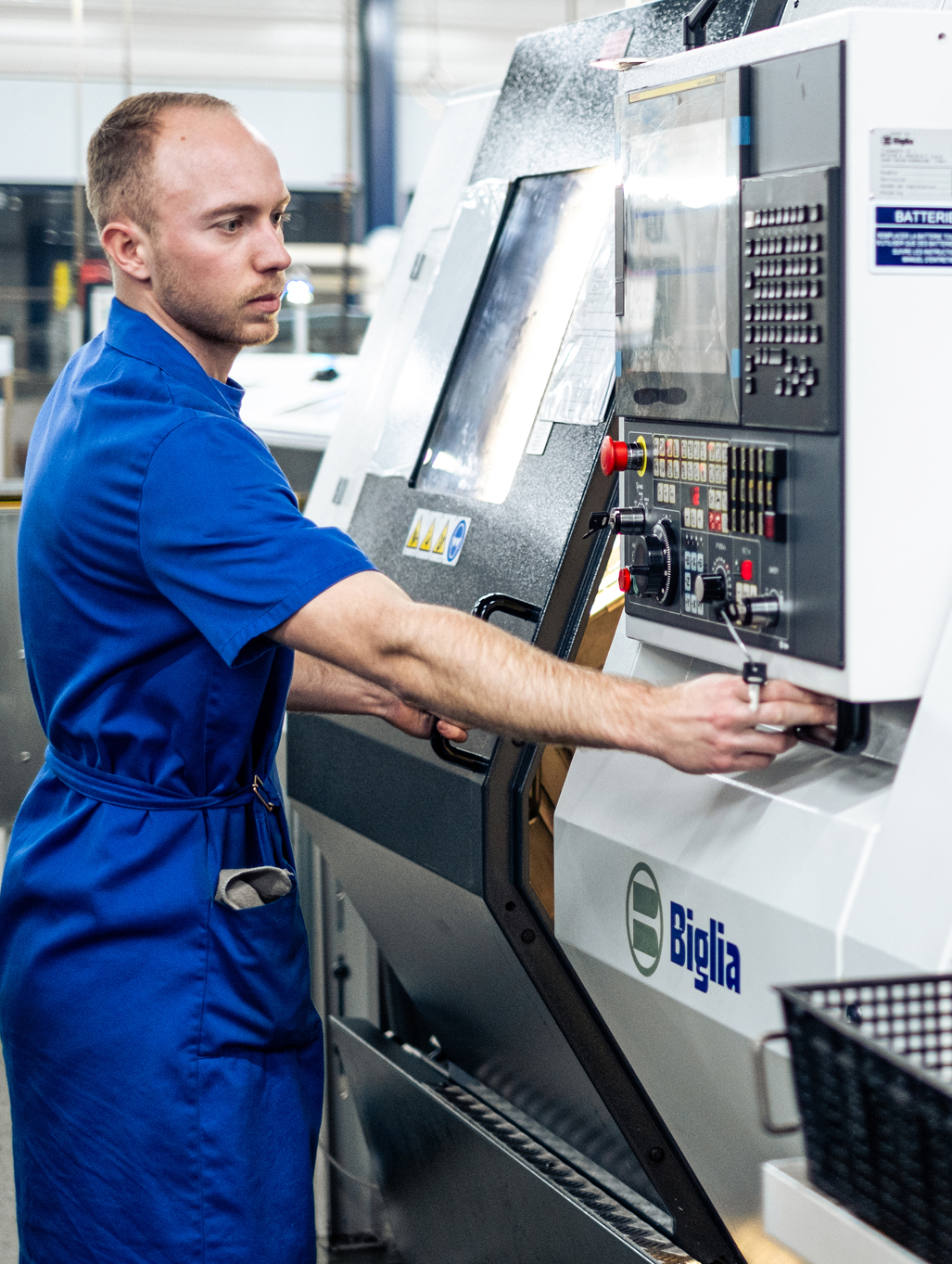
Why does the cam-operated single-spindle lathe still have its place in our workshop?

KEY POINTS
- A single-spindle lathe machines one bar at a time: one part leaves the machine with each revolution of the camshaft.
- The cams control every tool movement. Once set up, the machine repeats the same cycle over hundreds of thousands of parts.
- Simpler than a multi-spindle lathe, it covers a much wider diameter range, from very small parts to large diameters.
- JACQUEMOUX DÉCOLLETAGE operates 24 cam-operated single-spindle lathes: fixed-headstock Manurhin machines from Ø 5 to 60 mm and sliding-headstock Tornos machines from Ø 2 to 10 mm.
———————————–
They are said to belong to another era, yet they still hold a central place in our workshop, with 24 machines in production. Their simple, robust mechanical design allows them to repeat the same cycle hundreds of thousands of times with great consistency.
This article describes how these machines work, the difference between our fixed-headstock and sliding-headstock single-spindle lathes, the parts and volumes they are suited to, and their place alongside our numerically controlled lathes and multi-spindle machines.
How Does a Cam-Operated Single-Spindle Lathe Work?
The principle comes down to two ideas: a single spindle driving a single bar, and a camshaft that orchestrates every movement of the machine.
One Spindle, One Bar, One Part at a Time
The spindle clamps the bar stock and rotates it. Around it, several tools work one after another: longitudinal turning, form turning, drilling, threading, then parting-off. When the part drops, the bar feeds forward for the next one and the cycle begins again. Unlike the multi-spindle lathe, which works several bars in parallel, the single-spindle lathe carries out its operations in sequence on a single part.
The Camshaft, Conductor of the Cycle
Each tool receives its movement from a cam, a disc with a profile cut specifically for the part to be produced. All these cams rotate on the same shaft, which completes one full revolution per machining cycle. The profile of each cam determines when the tool advances, at what speed, how far, and when it retracts.
The cam set therefore plays the role of the program on a numerically controlled machine, with one difference: it is mechanical. Once set up, it does not drift and repeats exactly the same cycle, part after part.
A Long-Standing Expertise of French Industry
Cam-operated single-spindle lathes accompanied the development of bar turning throughout the 20th century. Manurhin, which makes up a large share of our machine fleet, began manufacturing automatic bar turning lathes as early as 1935, according to the manufacturer’s history, before setting up production of cam-operated lathes in Mulhouse after the war.
Fixed or Sliding Headstock: Two Families of Single-Spindle Lathes
The cam-operated single-spindle lathe exists in both architectures presented in our articles on the fixed headstock and the sliding headstock. Our workshop operates both.
Fixed-Headstock Manurhin Lathes, from Ø 5 to 60 mm
On these machines, the spindle stays in place and the tools come to work the bar. This rigid architecture accommodates large diameters. Our 16 Manurhin lathes are divided into three capacities:
- 8 machines from Ø 5 to 25 mm;
- 7 machines from Ø 10 to 42 mm;
- 1 machine from Ø 10 to 60 mm.
Sliding-Headstock Tornos Lathes, from Ø 2 to 10 mm
On our 8 Tornos lathes, the headstock moves forward and slides the bar through a guide bush, which supports it as close as possible to the tools. This principle, inherited from watchmaking, is ideal for very small-diameter, long and slender parts. With a capacity starting at Ø 2 mm, these machines go smaller than any other equipment in our fleet.
Which Parts Suit a Single-Spindle Lathe?
The single-spindle lathe meets a specific need: producing high volumes of parts with a stable geometry, across a diameter range that the multi-spindle lathe does not always cover.
Very High-Volume Production of Stable Parts
As with multi-spindle lathes, designing and setting up the cams represents an initial investment. It pays off on high-volume production: our single-spindle lathes produce from 25,000 to 1,000,000 parts per production run. For smaller volumes or frequently changing part numbers, our numerically controlled lathes offer greater flexibility.
Diameters Beyond the Reach of Multi-Spindle Lathes
Our multi-spindle lathes work from Ø 3 to 25 mm. The single-spindle lathe extends this range in both directions: towards very small diameters with our Tornos machines from Ø 2 mm, and towards large diameters with our Manurhin lathes up to Ø 60 mm.
Typical Part Families
The cam-operated single-spindle lathe is particularly suited to:
- screws, nuts and threaded parts;
- pins and rods, including very small diameters on sliding headstock;
- spacers, bushes, sleeves and end fittings;
- larger-diameter bodies and fittings on fixed headstock.
These parts are found in sectors such as the automotive industry, the construction sector, energy and machinery and equipment.
Send my drawings and parts to JACQUEMOUX DÉCOLLETAGE
What to Plan Before a Single-Spindle Production Run
Robust and cost-effective in series production, the single-spindle lathe does, in return, require a little forward planning.
Set-Up to Be Scheduled
Changing part numbers means fitting a new cam set and adjusting each tool. This set-up time encourages grouping requirements into large production runs rather than a series of small orders.
Secondary Operations Depending on the Part
Cam-operated lathes perform turning, axial drilling and threading operations. When the part features cross holes, flats or milled features, our conventional secondary operation machines (milling, tapping, drilling) and our grinding machine take over. Our additional services then complete the part: surface treatments and sub-assembly.
Geometry Validated Upstream
A drawing that changes after the cams have been made is costly. Our prototyping and pre-production service lets you validate geometry and material before committing to very high-volume production.
Our Fleet of 24 Cam-Operated Single-Spindle Lathes
These machines are part of our small to medium-volume production capability, alongside our CNC lathes and multi-spindle machines. They cover:
- 16 fixed-headstock Manurhin lathes, from Ø 5 to 60 mm;
- 8 sliding-headstock Tornos lathes, from Ø 2 to 10 mm;
- runs of 25,000 to 1,000,000 parts per production run;
- our main materials: steel, stainless steel, brass, copper, aluminium and plastics.
Our ISO 9001, IATF 16949 and ISO 14001 certifications govern all of this production.
Your Questions About Cam-Operated Single-Spindle Lathes
The questions that come up most often when comparing this technology with others.
What Is a Single-Spindle Lathe?
It is an automatic lathe that machines a single bar of material at a time. Its tools work on the part in succession, through to parting-off, then the bar feeds forward for the next part.
What Is the Difference Between a Cam-Operated Lathe and a Numerically Controlled Lathe?
On a cam-operated lathe, mechanical cams control the tool movements: each new part requires a new cam set. On a numerically controlled lathe, a program drives the axes, making it much quicker to change part numbers. The cam-operated lathe remains highly competitive for high-volume production of stable parts.
What Diameters Can Be Machined on a Single-Spindle Lathe?
It all depends on the machine. Our single-spindle fleet covers Ø 2 to 10 mm on sliding headstock (Tornos) and Ø 5 to 60 mm on fixed headstock (Manurhin).
Why Do Some Parts Need Secondary Operations After the Cam-Operated Lathe?
The cam-operated lathe excels at rotational operations: turning, axial drilling, threading and parting-off. Cross holes, flats or milled features sometimes require a second operation on a secondary operation machine. We carry out these operations in our own workshop, so you receive a finished part.
A Production Run to Launch on a Cam-Operated Lathe?
Send us your drawing and forecast volumes: we will identify the most suitable machine – single-spindle, multi-spindle or numerical control – and send you a detailed quotation.