Machining Round Bar Stock: The Specifics of Form Turning
Do you have a project involving round aluminium parts to be machined?
KEY POINTS
|
Whether on a cam-operated lathe or a numerical control lathe, a round part is more than just a smooth cylinder: shoulders, grooves, fillets and chamfers can all be produced without changing tools or multiplying secondary operations. This is the principle of form turning, a technique that makes the most of the rotational symmetry of round bar stock to machine a complex contour in a single pass. At JACQUEMOUX DÉCOLLETAGE, this approach is applied in particular to aluminium parts, where productivity and repeatability are crucial in high-volume production.
What Is Form Turning?
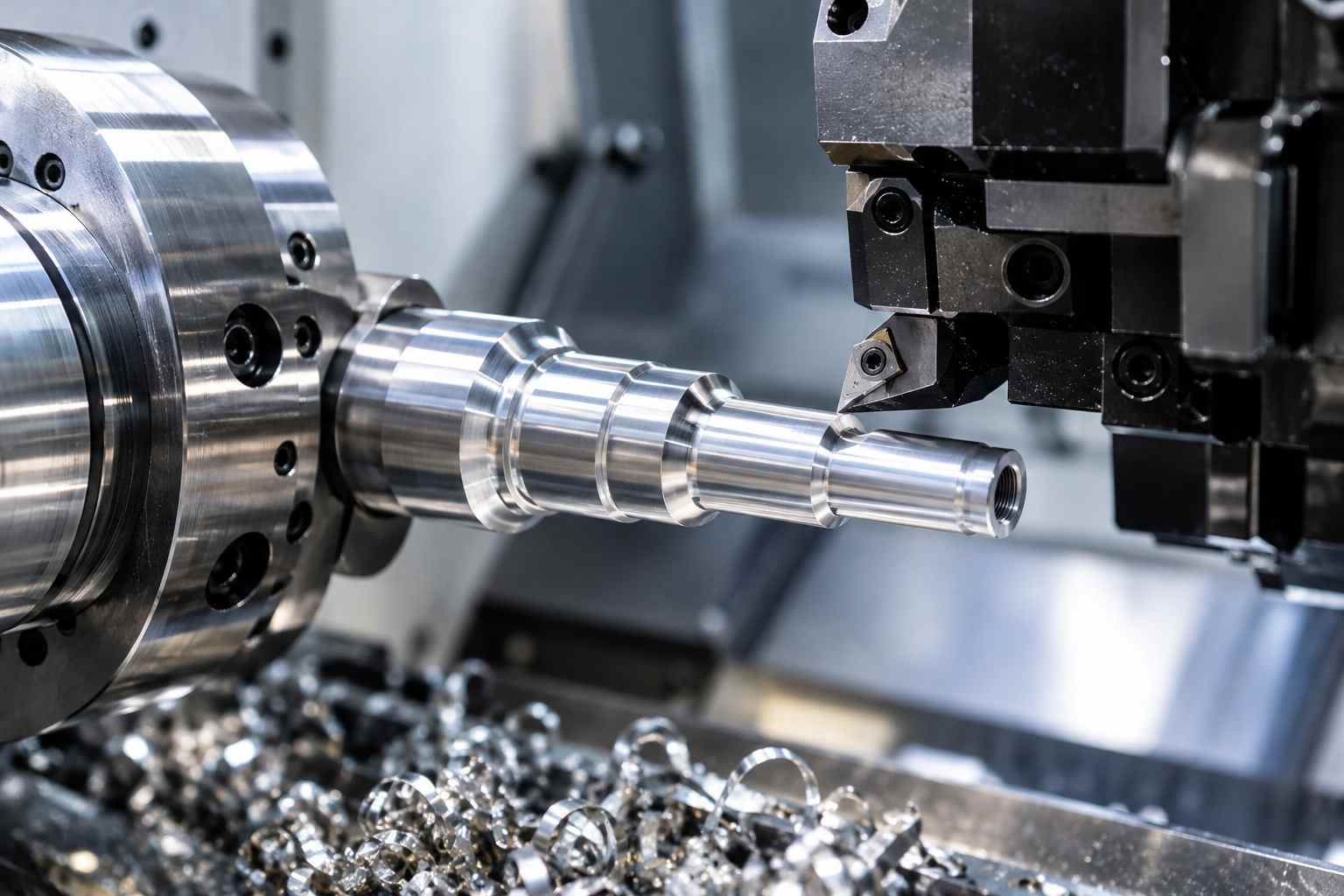
Form turning involves machining a complete longitudinal profile using a tool whose cutting edge has been shaped to reproduce, in a single radial plunge, the sequence of diameters, radii and angles that make up the final geometry of the part. Unlike conventional cylindrical machining, which uses several tools and several passes to face each diameter separately, the form tool “prints” the contour directly into the material.
On cam-operated lathes, this movement is driven by a mechanical profile that synchronises the tool feed rate with the rotation of the bar. On numerical control (NC) lathes, although contouring by interpolation with standard tools is often preferred for flexibility, using a dedicated form tool remains a highly effective strategy in very high-volume production. The aim is then to drastically reduce cycle times by replacing multiple movements with a single plunge.
Why Round Bar Stock Is the Benchmark Format
This technique comes into its own on turned parts, i.e. parts produced from round bars. Symmetry around the axis of rotation allows the form tool to follow a consistent contour through 360°, with no discontinuity or secondary milling operation. A non-circular profile, by contrast, would require additional operations to machine the flat faces, which defeats the very purpose of form turning: machining as much geometry as possible in as few operations as possible.
This is why round parts (shafts, bushes, spacers, fitting bodies) are the natural territory for this technique, for medium runs as well as for very high-volume production.
The Specific Features of Machining Round Aluminium Bar Stock
Aluminium has a machinability profile that is particularly well suited to form turning. Its cutting speed, 3 to 5 times higher than that of steel, allows the form tool to plunge at a high production rate without compromising surface finish – a direct advantage for productivity in high-volume production.
The choice of grade nevertheless remains decisive. 2011, a dedicated free-machining grade, produces short, regular chips that are particularly well suited to high-rate machining with form tools. Grades 6060 and 6082, for their part, offer a good balance between machinability, weldability and mechanical strength, making them versatile choices for round parts intended for assemblies. Conversely, grades such as 5052, which are more ductile and produce longer chips, require closer attention to chip control when used in form turning.
In all cases, lubrication and chip evacuation remain the two critical parameters: a form tool engages several cutting zones simultaneously, making chip accumulation or material build-up more detrimental than in conventional cylindrical turning.
The Benefits of Form Turning for Your Round Aluminium Parts
By combining several turning operations into a single tool movement, form turning reduces the number of tool changes and therefore the cycle time per part, a saving that is passed directly on to the unit cost in high-volume production. It also improves dimensional repeatability: as the profile is reproduced identically with each plunge, part-to-part variations are kept to a minimum, making it easier to hold tight tolerances on complex geometries.
| Criterion | Form turning | Conventional cylindrical turning |
| Tools used | A single profiled tool | Several successive tools |
| Number of passes | A single plunge | Several passes |
| Cycle time | Reduced | Longer |
| Dimensional repeatability | High, profile reproduced identically | Depends on the number of operations |
| Initial tooling cost | Higher (custom tool) | Standard |
| Most suitable production run | High-volume production | Small batch / prototyping |
This approach is equally suited to functional technical parts (retaining rings, profiled spacers, fitting bodies) and to parts where appearance matters, as aluminium lends itself well to high-quality finishing after machining.
Frequently Asked Questions about Form Turning
Is form turning suitable for all batch sizes?
This technique is particularly cost-effective in high-volume production, as the cost of making the custom form tool is offset by the volume produced. For small batches or prototyping, conventional cylindrical machining by contouring (on NC machines) is often the more economical option.
What tolerances can be achieved on an aluminium part produced by form turning?
As a general rule, precision bar turning of aluminium makes it possible to achieve and maintain tight tolerances in the region of a hundredth of a millimetre (± 0.01 mm). Naturally, the final precision will depend on the aluminium grade chosen, the width of the form tool and the geometry of the part.
Do You Have a Round Parts Project?
From choosing the grade to defining the form profile, the technical team at JACQUEMOUX DÉCOLLETAGE will study your specifications and propose a solution tailored to your volumes and tolerances.


