Bar turning for aerospace: the demands of precision
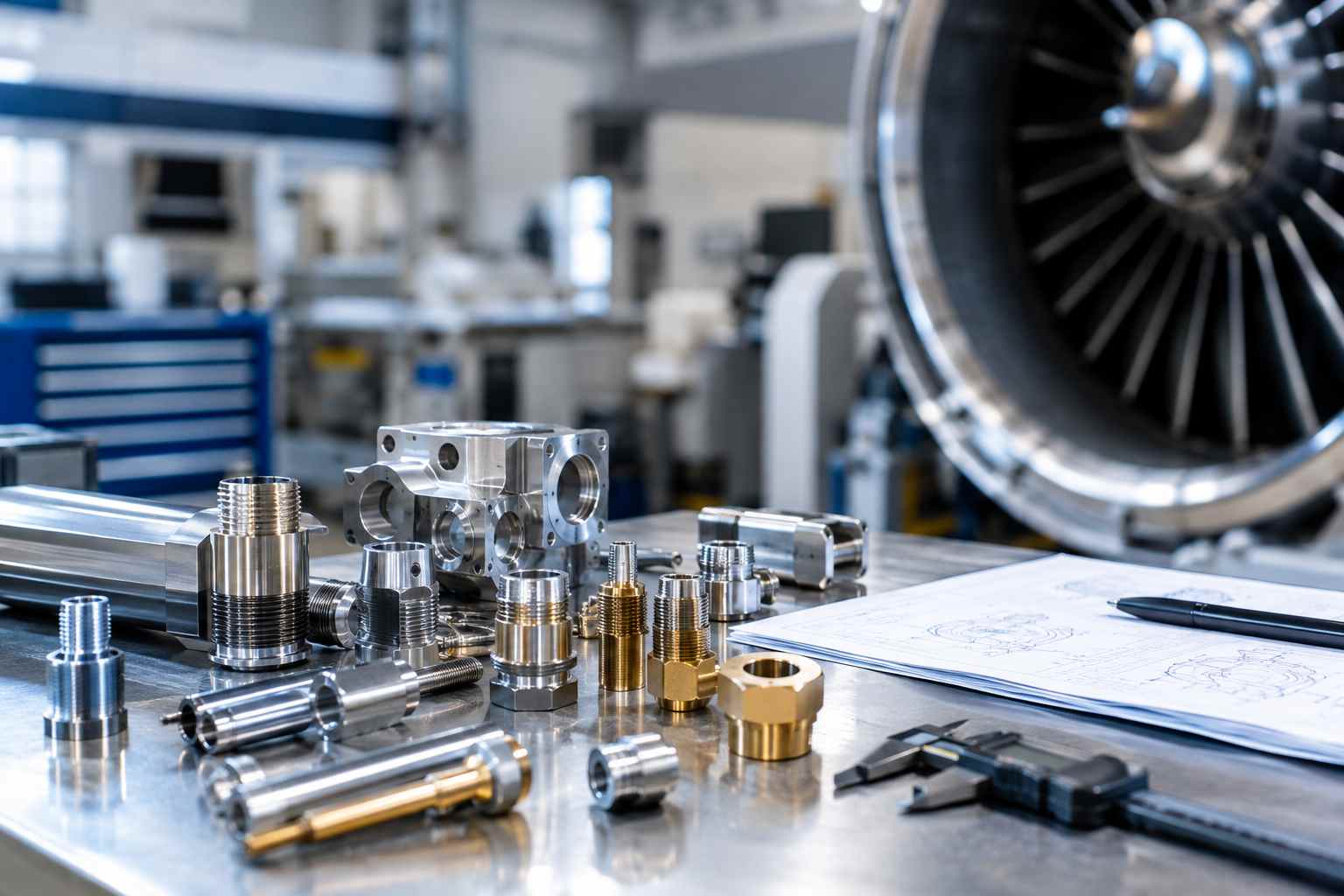
Do you have a project for turned parts for the aerospace industry?
→ Submit my project
KEY TAKEAWAYS
- Aerospace bar turning demands tight tolerances and full material traceability, checked at every stage of production.
- JACQUEMOUX DÉCOLLETAGE is certified ISO 9001, IATF 16949 and ISO 14001, without EN 9100 certification to date: a foundation that nonetheless enables it to meet a large share of the sector’s demand.
- The most widely used grades are 2024/7075 aluminium and 316L/17-4PH stainless steel, each meeting a need for weight reduction, strength or corrosion resistance.
- Material traceability relies on EN 10204 material certificates (type 3.1), combined with dimensional inspection on a coordinate measuring machine.
- On critical parts, non-destructive testing (dye penetrant testing, magnetic particle inspection, ultrasonic testing) supplements standard dimensional inspection.
—————–
An aerospace fastener weighing just a few grams may have to withstand tens of thousands of vibration cycles and extreme temperature variations without ever failing. This requirement shapes the entire specifications of a turned part intended for the sector: the slightest dimensional deviation or undetected material defect can have consequences out of all proportion to the size of the part. This is the level of demand that JACQUEMOUX DÉCOLLETAGE meets in its production of aerospace parts, drawing on expertise built up since 1960 in the Arve Valley.
The Specific Requirements of Bar Turning for the Aerospace Industry
Three requirements shape the production of turned parts for this sector: tight dimensional tolerances, complete material traceability and documented quality control at every stage.
| Requirement | What it involves | JACQUEMOUX DÉCOLLETAGE’s response |
| Tight tolerances | Dimensional repeatability across the entire batch | In-process inspection + coordinate measuring machine |
| Material traceability | Identification of each batch of bars | EN 10204 material certificates (type 3.1) |
| Inspection of critical parts | Detection of internal defects invisible to the naked eye | Non-destructive testing: dye penetrant testing, magnetic particle inspection, ultrasonic testing |
| Documented quality framework | Formalised and audited processes | ISO 9001, IATF 16949, ISO 14001 certifications |
Certification and Compliance: Where Does JACQUEMOUX DÉCOLLETAGE Stand?
The aerospace sector relies heavily on the EN 9100 standard, a specific certification that JACQUEMOUX DÉCOLLETAGE does not currently hold. The company does, however, rely on an already demanding quality foundation (ISO 9001, IATF 16949 (automotive) and ISO 14001 (environment)) combined with traceability and dimensional inspection processes that genuinely meet a large share of the sector’s needs, particularly for standard parts or in mid-tier subcontracting.
Each project begins with a preliminary discussion to check that the customer’s specifications are compatible with the company’s current quality framework.
Which Grades Are Used in Aerospace Bar Turning?
The choice of grade depends first and foremost on the part’s function in the aircraft. TA6V titanium (Grade 5) remains the benchmark for structural parts and fasteners, thanks to a strength-to-weight ratio that few other metals can match; machining it, however, requires moderate cutting speeds and generous lubrication to offset its low thermal conductivity.
For parts where weight reduction takes priority without the same mechanical constraints, 2024 and 7075 aluminium grades are preferred for their high strength, although residual stresses during machining must be carefully anticipated. Finally, stainless steel 316L and 17-4PH are used for parts requiring high mechanical strength or corrosion resistance, particularly components subject to repeated stress.
Typical Applications in Aerospace Bar Turning
These grades are found in recurring families of aerospace parts: fasteners and structural shafts, hydraulic and pneumatic fittings, connector technology and on-board systems components, and parts used in powertrain sub-assemblies. The variety of supply formats (round bars, hexagonal bars, billets) makes it possible to adapt the starting geometry to the complexity of each part.
Frequently Asked Questions about Aerospace Bar Turning
Is EN 9100 certification required to have aerospace parts bar-turned?
It is required by some customers, particularly for tier-1 critical parts. For many projects, an ISO 9001 quality framework combined with rigorous material traceability and dimensional inspection is sufficient to meet the specifications. An early discussion with your bar turner allows you to check this compatibility before launching a project.
What batch volumes are suited to aerospace bar turning?
Bar turning is equally suited to prototypes and to medium or large series, depending on the programme phase. A prototyping and pre-production service makes it possible to validate a geometry before a production run.
Do You Have an Aerospace Parts Machining Project?
From selecting the grade to final inspection, the JACQUEMOUX DÉCOLLETAGE technical team will study your specifications and tell you clearly whether the company’s current quality framework meets your requirements.


